Finding gold
I saw a post on LinkedIn the other day that made me pause. The most notable quote:
If every company uses the same AI to make decisions and build products, everything regresses to the mean. Same tools, same thinking, same output. The way to win is to be different and that comes from deeper customer understanding, not by doing a course on how to prompt cursor.
I’ve launched at least a dozen websites over the last year (marketing websites, apps, directories, micro-tools) and only one has gained any real traction. Because the cost of development is just my time, a $20 Claude subscription, and a $15 domain, it’s easy to keep spamming sites. But recently my wallet got tired of buying domains that went nowhere. So I decided to go back to my roots of product management and do some actual research instead of getting swept up in the latest shiny idea.
If you go on X or LinkedIn it seems like everyone is using Claude Code and creating microtools and websites. Your competitive edge decreases significantly when the barrier to entry drops. A simple example: scribes. It used to be that scribes were incredibly valuable and highly respected because they were some of the few in society who were literate and could write. Then enter the printing press, and their entire job was wiped out.
When everyone can create a vibe-coded invoice generator in an evening and publish it on the internet, the value of that asset drops significantly. It becomes much harder to differentiate, gain traction, or grow.
So I decided that if I was going to buy another domain, I better have some proof to back it up. Enter keyword research. Check out these beautiful keywords:
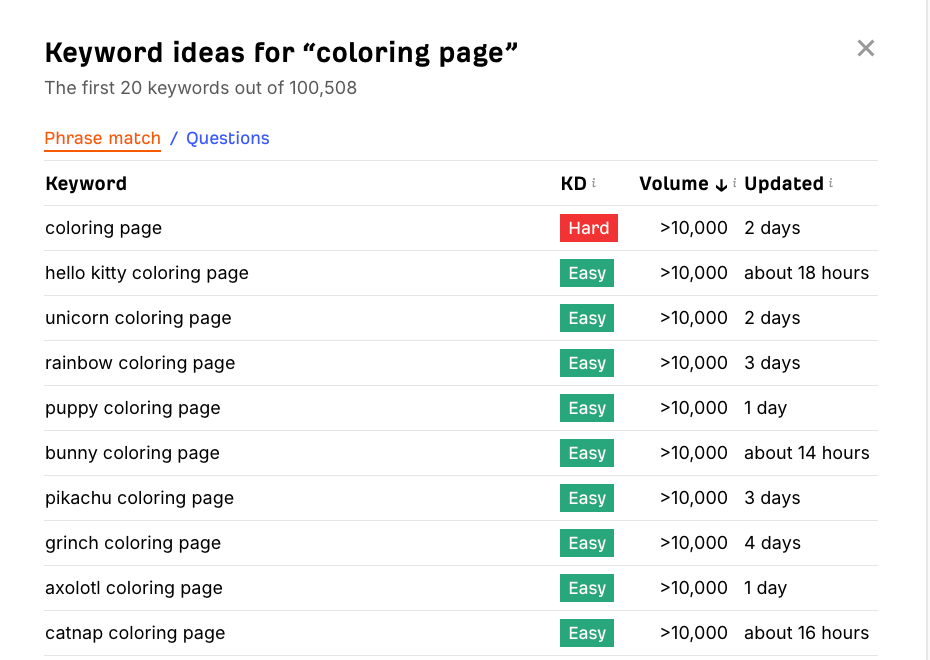
That’s my pot of gold. I didn’t stumble upon these by dumb luck. I took a strategic approach. I got access to Site Stats Database and combed through thousands of websites to find ones getting decent traffic that could be monetized (10-40k monthly visits), growing traffic, and low domain authority. Then I used Ubersuggest, Ahrefs, and Semrush to validate the traffic and find high-volume, low-competition keywords. And THEN I started building.
I just launched the site a few days ago, so I hope to have an update in a few months on whether this strategy panned out. But for the first time in a while, I’m feeling genuinely hopeful that I have something valuable, rather than just another vibe-coded site. The difference is I took a surgical approach to finding the niche, rather than just building whatever sounded good.
Everyone else is sprinting to launch things, but the advantage right now might just be pausing long enough to ask whether it’s worth building at all.
Thanks for reading!